





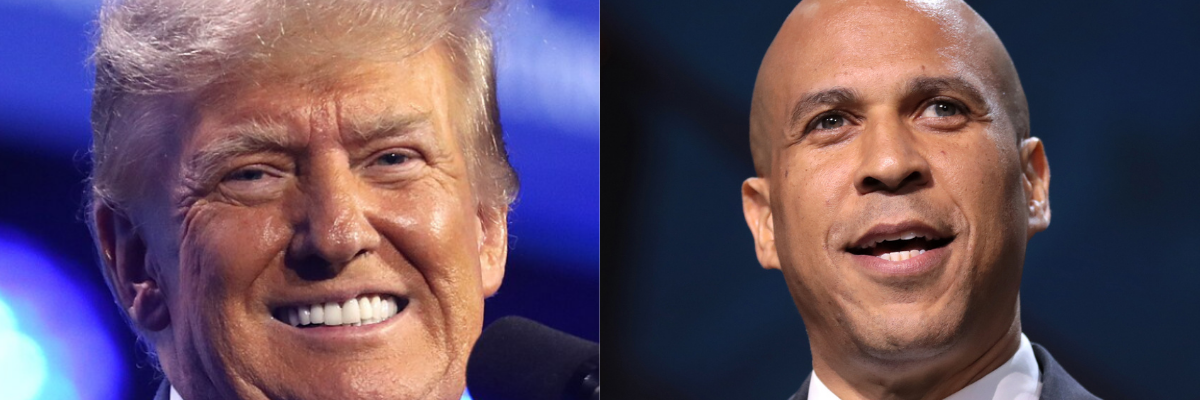
US Senator Cory Booker’s (D-NJ) bill to legalize marijuana via descheduling and President Donald Trump’s (R) executive order to move it to a lower tier are advancing and creating a collision course.
Table of Contents
“The continued federal prohibition of marijuana is increasingly out of step with public opinion, state laws, and scientific evidence,” said NORML political director Morgan Fox.
Booker’s Descheduling Bill and Its Mechanisms
According to Patch, Booker introduced the Cannabis Administration and Opportunity Act alongside Senator Chuck Schumer of New York and Senator Ron Wyden of Oregon. The bill would remove marijuana from the list of federally controlled substances altogether, leaving each state to set its own rules on production and sale.


The legislation goes well beyond a simple scheduling change. Under its terms, prior non-violent marijuana convictions would be automatically expunged. Also, people serving federal prison sentences for marijuana offenses would be permitted to apply for resentencing. The bill would also create a comprehensive regulatory framework governing production, sale, and taxation of cannabis, end unnecessary drug testing for federal employees, and expand job protections for workers in the cannabis industry.
Booker has been pushing versions of this legislation for nearly a decade. He introduced comparable reform bills in 2017 and 2024 and has separately advocated for ending marijuana-related evictions from public housing.
Fox framed the stakes plainly in support of the bill.
“Nearly all Americans live in jurisdictions where cannabis is legal for either medical or adult use,” Fox said. “It is time for Congress to enact policies that reflect this reality and finally bring the failed experiment of marijuana prohibition to a close.”


Fox noted that nearly every state has enacted some form of medical cannabis law, and 24 states plus several territories currently regulate adult-use possession and sale.
Trump’s Rescheduling Order and the Tax Consequence
Trump signed an executive order in December directing the U.S. Attorney General to expedite rescheduling marijuana from Schedule I to Schedule III of the Controlled Substances Act (CSA).
“I want to emphasize that the order I am about to sign doesn’t legalize marijuana in any way, shape or form, and in no way sanctions its use as a recreational drug,” Trump said at the time.
He added that the facts compel the federal government to recognize marijuana can be legitimate in medical applications when carefully administered.
The distinction between Schedule I and Schedule III is substantial. Marijuana currently sits alongside heroin, cocaine, and methamphetamine as a Schedule I substance. Schedule III includes drugs such as Tylenol with codeine, ketamine, and anabolic steroids. Moving marijuana to Schedule III would allow licensed cannabis businesses to take standard tax deductions that federal law currently denies them, a change that could stabilize the industry and potentially lower consumer prices. It would also ease restrictions on researching the medical benefits of cannabis.
In April, the acting US Attorney General signed an order reclassifying state-licensed medical marijuana to Schedule III to advance Trump’s December directive. The full proposal must still clear the federal rulemaking process before taking legal effect.
Republican Opposition and Booker’s Conditional Welcome
The April reclassification drew immediate pushback from Trump’s coalition. A group of 22 Republican Senators sent Trump a letter warning that moving marijuana to Schedule III “will undermine your strong efforts to Make America Great Again…”
Booker offered a cautious welcome to the April action while making clear it falls short. The reclassification brings financial and operational benefits to legal businesses in New Jersey, he said, but framed it as insufficient.


“There is still a long way to go,” Booker said. “Unauthorized possession remains a crime. People will still be prosecuted, detained, and deported for marijuana offenses. Some will continue to serve prison sentences. Others will carry criminal records that follow them for years. This is why we must de-schedule cannabis altogether.”
New Jersey’s Regulatory Baseline
The federal debate unfolds on top of a state framework that has been evolving for more than fifteen years. New Jersey passed a medical marijuana law in 2010.
Voters approved recreational adult use in November 2020, and then-Governor Phil Murphy signed the formal legal structure into law in February 2021.
Under that framework, adults 21 and older may possess up to six ounces of cannabis and cannabis products. Home cultivation is not permitted. Purchases must be made at a licensed dispensary, and the New Jersey Cannabis Regulatory Commission caps a single transaction at 28.35 grams of usable cannabis, or the equivalent in concentrates, oils, or edibles up to 1,000 milligrams.


That structure is stable at the state level. But what remains unresolved is whether federal law will align with it, supersede it, or continue to create the legal friction that has defined the cannabis industry’s relationship with banking, taxation, and interstate commerce since New Jersey’s dispensaries first opened.
Booker’s closing warning offers the starkest summary of where things stand: unauthorized possession is still a federal crime, and people are still being prosecuted for it.
Federal Reform as a Technology Story
The Geek HR editorial team, which covers technology, science, and digital trends for Croatian readers, observes that whenever federal rules redraw the operating boundaries of a regulated adult industry, the immediate practical consequence is a technology story. The compliance infrastructure that businesses must build, the digital commerce rails that dispensaries depend on, the seed-to-sale tracking systems that regulators require — all of it would need to be rebuilt or substantially adapted if either the Booker or Trump approach becomes law. A full descheduling would demand that software vendors, payment processors, and e-commerce operators reconceive how a cannabis business functions legally at national scale, not merely within state lines. geek.hr covers exactly this technological and digital-trends dimension of how emerging regulated markets move online, translating that complexity for its readers.