




US Senate Democrats reintroduced the Cannabis Administration and Opportunity Act (CAOA), which would legalize cannabis through descheduling.
The bill would remove cannabis from the Controlled Substances Act (CSA) list and end federal marijuana prohibitions in states that have chosen to legalize medical cannabis or adult-use cannabis.
Table of Contents
- Booker Leads Reintroduction of Federal Cannabis Descheduling Bill
- Cannabis Descheduling Bill Provisions
- Anti-Underground Legacy Public Safety Measures
- Federal Cannabis Taxation and Regulation
- Encourage Cannabis Research
- Prioritize Restorative and Economic Justice
- Strengthen Workers’ Rights
- Many Senate Cosponsors for Federal Cannabis Descheduling
- NORML Endorses Cannabis Descheduling Bill
- National Cannabis Politics
It would help consumers living in states with anti-marijuana laws being eagerly enforced.
However, the bill does include strong anti-underground legacy market provisions, including going after them.


It is certain that the bill would also eliminate 280-E from the IRS Tax Code. The bill would likely open cannabis interstate commerce as well.
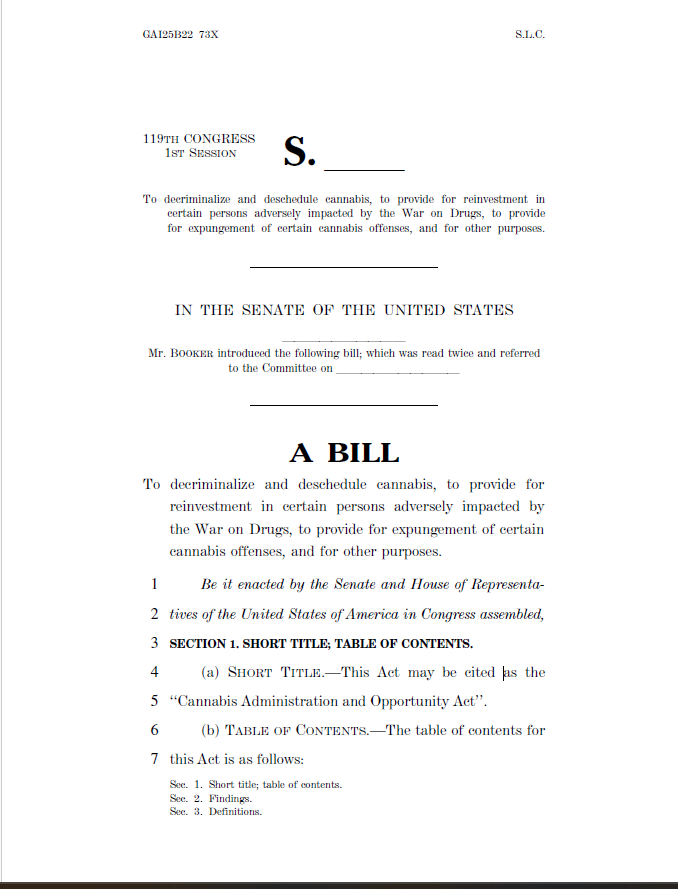
Booker Leads Reintroduction of Federal Cannabis Descheduling Bill
U.S. Senators Cory Booker (D-NJ), Senate Democratic Leader Chuck Schumer (D-NY), and Ron Wyden (D-OR) reintroduced the bill with Booker leading the charge.
“For decades, generations have suffered unjustly under the failed War on Drugs and broken cannabis laws,” Booker declared.
He noted it has hurt primarily people of color.


“It is long overdue that we stand up for them,” Booker added.
“The over-criminalization of cannabis has destroyed far too many lives, disproportionately harming communities of color,” said Schumer.
“The movement is budding, and I won’t stop until restorative justice is achieved. The American people overwhelmingly support the federal legalization of cannabis,” he added.
“The only reefer madness I’m seeing is the continued federal prohibition of cannabis,” said Wyden. “Our legislation is the most comprehensive proposal on the books to end federal cannabis prohibition while keeping public health and safety front and center. The federal government needs to get with the times, and our bill is the way to do it.”
Cannabis Descheduling Bill Provisions
The federal cannabis descheduling bill is very comprehensive. It would:
- Establish a federal Center for Cannabis Products to regulate production, labeling, distribution, sales, and other manufacturing and retail elements of the cannabis industry.
- Instruct the Federal Drug Administration (FDA) to establish labeling standards for cannabis products, including potency, doses, servings, place of manufacture, and consumption directions.
- Establish expedited FDA review of drugs containing cannabis manufactured by small businesses owned by socially and economically disadvantaged individuals.
- Establish programs and funding to prevent youth cannabis use.
- Increasing funding for opioid, stimulant, and substance use disorder treatment.
Anti-Underground Legacy Public Safety Measures
Unfortunately, a lot of compromises were made in the process. The bill would:
- Establish a grant program “to help departments combat black market cannabis.”
- “Retaining federal prohibitions on trafficking cannabis in violation of state law.”
- Incentivize states to adopt cannabis open-container laws.
- Directing the National Highway Traffic Safety Administration (NHTSA) to collect data on cannabis-impaired driving, create educational materials on best practices, and carry out media campaigns.


Federal Cannabis Taxation and Regulation
The bill would establish federal taxation of cannabis by:
- Implementing an excise tax on cannabis products.
- Establishing market competition rules meant to protect independent producers, wholesalers, and retailers and prevent anti-competitive behavior.
- Transferring federal jurisdiction over cannabis to the Alcohol and Tobacco Tax and Trade Bureau (TTB).
- Eliminating the tax 280-E code restriction on cannabis businesses claiming deductions for business expenses.
Encourage Cannabis Research
The bill would also:
- Require the Department of Health and Human Services (HHS) and the National Institutes of Health (NIH) to conduct or support research on the impacts of cannabis.
- Require the Veterans Administration (VA) to conduct trials studying the effects of medical cannabis on veterans with chronic pain and Post-Traumatic Stress Disorder.
- Require the Bureau of Labor Statistics to compile data on the demographics of business owners and employees in the cannabis industry.
- Establishing grants to build up cannabis research capacity at institutions of higher education, with a focus on minority-serving institutions and Historically Black Colleges and Universities.


Prioritize Restorative and Economic Justice
The bill would also:
- Use federal tax revenue for an Opportunity Trust Fund to reinvest in communities harmed by the War on Drugs.
- Establish a Cannabis Justice Office in the Department of Justice’s Office of Justice Programs.
- Establish a grant program to minimize barriers to cannabis licensing and employment for individuals adversely impacted by the War on Drugs.
- Direct the Housing and Urban Development to establish a grant program to provide communities whose residents have been disproportionately affected by the War on Drugs with funding to address the housing, economic, and community development needs.
- Initiate automatic expungement of federal nonviolent cannabis offenses.
- Allow an individual serving time in federal prison for a nonviolent cannabis offense to petition a court for resentencing.
- Disallow the denial of any benefits to noncitizens based on use or possession of cannabis.
- Prevent discrimination in federal benefits against cannabis consumers.
Strengthen Workers’ Rights
Finally, the bill would also:
- Establish grants for community education, outreach, and enforcement of workers’ rights in the cannabis industry.
- Removing federal employee pre-employment and random drug testing for cannabis.
- Ensuring worker protections for those employed in the cannabis industry.
Many Senate Cosponsors for Federal Cannabis Descheduling
The Cannabis Administration and Opportunity Act is cosponsored by Senators:
- Michael Bennet (D-CO)
- John Fetterman (D-PA)
- Kirsten Gillibrand (D-NY)
- John Hickenlooper (D-CO)
- Ben Ray Luján (D-NM)
- Alex Padilla (D-CA)
- Gary Peters (D-MI)
- Tina Smith (D-MN)
- Raphael Warnock (D-GA)
- Ed Markey (D-MA)
- Jeff Merkley (D-OR)
- Patty Murray (D-WA)
- Elizabeth Warren (D-MA)
- Peter Welch (D-VT).
NORML Endorses Cannabis Descheduling Bill
The National Organization for the Reform of Marijuana Laws (NORML) welcomed the reintroduction of the Cannabis Administration and Opportunity Act (CAOA).
“The continued federal prohibition of marijuana is increasingly out of step with public opinion, state laws, and scientific evidence,” said NORML Political Director Morgan Fox. “Nearly all Americans live in jurisdictions where cannabis is legal for either medical or adult use. It is time for Congress to enact policies that reflect this reality…”
National Cannabis Politics
In April, President Donald Trump’s (R) acting Attorney General Todd Blanche ordered the immediate rescheduling of state-licensed medical cannabis products and FDA-approved cannabinoid drugs to Schedule III.
However, this order is facing challenges in federal court, which could invalidate it.
A Drug Enforcement Administration (DEA) hearing process to consider moving cannabis to Schedule III concluded on July 15th. But a judicial recommendation has yet to be issued.
Unfortunately, the bill S 5022 does not yet have the necessary House of Representatives companion bill that would also need to pass for it to become law.
It’s a shame the bill was introduced so late into this session of Congress and so close to the midterm elections. After the new Congress takes office in January 2027, it would have to be introduced again.
A larger window existed for the same bill’s passage from July 2021 to January 2023.