





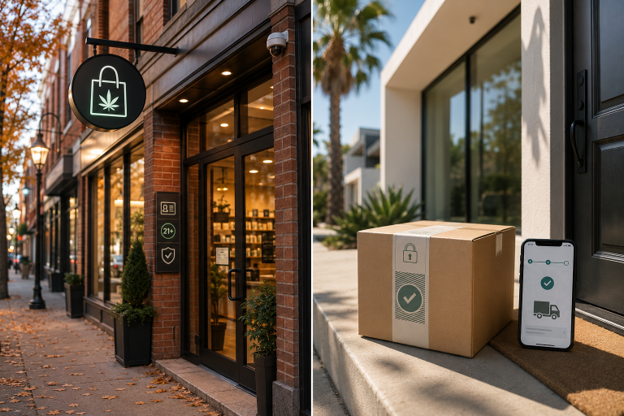
Both New Jersey and California have advanced adult-use cannabis markets. Yet they have followed completely different paths to obtain legal cannabis.
Table of Contents
- How Has Legal Cannabis Evolved in New Jersey and California?
- How Are New Jersey Cannabis Consumers Accessing Legal Weed in 2026?
- How Are California Cannabis Consumers Accessing Legal Weed in 2026?
- What Are Key Differences Between NJ and California Weed Delivery?
- What Does Future of Legal Weed Access Look Like for Both States?
- Why Is Cannabis Cheaper Through Delivery in California Than in New Jersey?
- How Do Consumers Verify Whether a Cannabis Delivery Service Is Licensed?
- Conclusion
(Photo above courtesy of IMAGE.)
In 2026, consumers are increasingly choosing licensed delivery over in-store dispensary visits.
How Has Legal Cannabis Evolved in New Jersey and California?
In November 2016, California voters approved Proposition 64. New Jersey began recreational cannabis sales in April 2022, almost six years after. The head start enabled California to create the most evolved delivery system for the legal cannabis market in the United States. By 2026:

- California has 7,912 licenses for commercial cannabis operators covering cultivators, retailers, distributors, and testing laboratories, according to the CA Department of Cannabis Control.
- New Jersey has more than 300 state-licensed medicinal and recreational dispensaries operating across all 21 counties, according to the NJ Cannabis Regulatory Commission (CRC).
- California operates a dual-license system separating retail storefronts from standalone delivery operators.
- New Jersey integrates delivery as an extension of dispensary licenses, along with standalone delivery licenses.
California’s head start has produced a more developed delivery infrastructure. Thus, California cannabis consumers can access a broader, more price-competitive delivery market than New Jersey’s.
How Are New Jersey Cannabis Consumers Accessing Legal Weed in 2026?
Access to cannabis in New Jersey depends on one’s location. A necessary compromise allows town governments to prohibit cannabis retail sales. It has resulted in large disparities in accessibility. Some key NJ cannabis trends are:
- Urban consumers in Newark, Jersey City, and Trenton have multiple dispensary options nearby
- Suburban and rural consumers in opted-out areas rely heavily on delivery from neighboring licensed dispensaries
- Medical patients have had delivery access since before recreational legalization, giving NJ’s delivery infrastructure an early foundation.


For context on how New Jersey’s dispensary landscape is developing, Heady NJ’s dispensary and industry coverage tracks openings, closures, and regulatory changes.
How Are California Cannabis Consumers Accessing Legal Weed in 2026?
California’s delivery market in 2026 is the most mature and cannabis consumer-friendly in the United States. A statewide delivery preemption law prohibits local governments from banning licensed deliveries even in jurisdictions that ban dispensaries.
According to the California Department of Cannabis Control, “licensed cannabis delivery services are allowed to operate throughout the State of California, and cannot be forbidden by local jurisdictions, thereby allowing the authorized organizations the right to deliver cannabis to their residences in California.”
So California consumers access legal weed through:
- Licensed dispensaries in marijuana-friendly cities such as Sacramento, Los Angeles, and San Francisco
- Licensed deliveries where there is no dispensary conveniently located
- Apps that help consumers locate dispensaries and obtain cannabis products
- Medical delivery programs for disabled or sick patients
For consumers across Northern California seeking convenient, compliant access, State-licensed weed delivery Sacramento services like Fiori Delivery operate under the California Department of Cannabis Control’s full regulatory framework. They offer same-day delivery of lab-tested, compliantly packaged products directly to residential addresses.
The New York Times noted that California’s approach to cannabis access has influenced delivery legislation in several states that are building their own frameworks.
What Are Key Differences Between NJ and California Weed Delivery?
The two states offer a contrast in how regulatory frameworks shape consumer experience.


Product variety:
- California: more licensed cultivators and brands mean broader product selection at the delivery level.
- New Jersey: growing rapidly, but delivery variety remains more limited than California’s mature market.
Pricing:
- California: the competitive market has driven prices down significantly since 2022, with many operators offering free delivery under a $50 minimum order.
- New Jersey: higher operating costs and limited delivery competition keep prices elevated
What Does Future of Legal Weed Access Look Like for Both States?
Both states are moving toward broader access but face different obstacles.

Notably, the NJ home-grow debate is gaining momentum as a secondary access pathway for underserved areas.
The problem facing licensed California cannabis operators is the unlicensed underground legacy market. It manages to grab a considerable portion of the total cannabis sales made in the state, according to the California Department of Tax and Fee Administration. Licensed delivery services have been dealing with the issue through same-day slots, compliance, and affordable pricing.
Key trends shaping both markets through 2027 are:
- The expansion of cannabis delivery apps and real-time order tracking
- Growth of subscription-based delivery models for medical cannabis patients and regular adult-use consumers
- Increased regulatory scrutiny of unlicensed delivery operators
- Rising consumer demand for lab-tested products with a verifiable chain of custody
Why Is Cannabis Cheaper Through Delivery in California Than in New Jersey?
In California, the standalone license for delivery services ensures that operators can operate without having to rely on retail establishments, resulting in low prices. In California, according to MJBizDaily, the price of cannabis has been significantly reduced since 2021 due to increased market competition, compared to New Jersey, where prices are higher due to less competition in licensing.
How Do Consumers Verify Whether a Cannabis Delivery Service Is Licensed?
If using a delivery service in California, check on their licensing status via the Department of Cannabis Control’s licensing database, which can be found at cannabis.ca.gov. For deliveries in New Jersey, the CRC’s website has a database of all licensed operators.
Conclusion
The cannabis markets that are most worth studying in 2026 are those of New Jersey and California in the US. They represent a mature market based on delivery services and a fast-developing one.
For consumers in either market, the priority is the same. Choose a licensed, verified operator with a clear chain of custody from dispensary shelf to front door.