






A New Jersey Cannabis Town Guide has been released by the State’s Cannabis Training Academy (CTA) to help towns that might want to allow cannabis companies.
The CTA’s PDF town guide is a very valuable tool for cannabis advocates, lawyers, entrepreneurs, consultants, urban planners, politicians, and elected officials looking to increase the number of NJ towns that allow cannabis.
Table of Contents
The cover is very lovely with the official seal of the State of New Jersey.


The CTA’s NJ town cannabis guide highlights the benefits of the 2 percent municipal tax on cannabis. The guide begins by saying, “Picture this: A neighboring town has a recreational cannabis dispensary. They are pulling in 2% local tax on those sales, filling a vacant storefront, and creating interest from other non-cannabis businesses to open in their town.”
“Meantime, your town council is watching and wondering: “Is this right for our town?” If so, what are the rules? How does this work? What could go wrong? How do we uphold public safety? This guide answers all of that. Think of this document as a GPS for cannabis policy.”
NJ Town Guide on Cannabis Details
According to the Guide, “Opting-in is NOT as simple as saying “yes” at a council meeting. It takes real planning.”
The guide lays out the steps required to opt in:


- “Write a new law (ordinance) that spells out the rules.
- Decide WHERE in town these businesses can go.
- Decide HOW MANY businesses to allow.
- Develop a process for reviewing applications from business owners
- Learn and stay updated on the New Jersey Cannabis Regulatory Commission’s
- (NJCRC) rules.”
The guide explains that “…opting-in is like deciding to allow a new type of restaurant in town. You still get to decide the zoning, the health standards, and the hours. Cannabis is similar — just with more local requirements and paperwork that needs to go to the New Jersey Cannabis Regulatory Commission.”
Town Control and Cannabis
The guide goes over a lot of helpful information, like “What Your Town CAN Control”
- “Where businesses can be located (zoning)
- How many businesses you allow (license caps)
- Hours of operation
- Local fees (as long as they’re reasonable)
- Your own local application process
- Who reviews local applications”
But they can’t control:
- “State scoring of applicants
- What cannabis products are sold
- Final state license approvals
- State investigations of businesses
- Base property security requirements set by state law”
How Cannabis is Regulated by NJ Towns
The guide reviews the range of ways NJ towns have regulated cannabis:
- “Type A — Simple (“Just Let Us Know You’re Legit”) Towns like Lafayette Township keep it straightforward: prove you have a state license, show that your zoning is good, submit a basic security plan, and you’re in. No scoring, no committee, no 50-page narrative. Fast and low-friction.”
- Type B — Moderate (“Show Us Your Plan”) Towns like Ocean Township or Garfield ask for a few more documents — a community impact summary, odor control plan, and operational details — but still don’t run a competitive scoring process.
- Type C — Comprehensive (“Make Your Case”) Towns like Morristown or Neptune City run a full RFP-style process with scoring criteria, advisory committees, capped slots, and detailed narrative requirements.”


They also outline the different ways that NJ towns regulate cannabis:
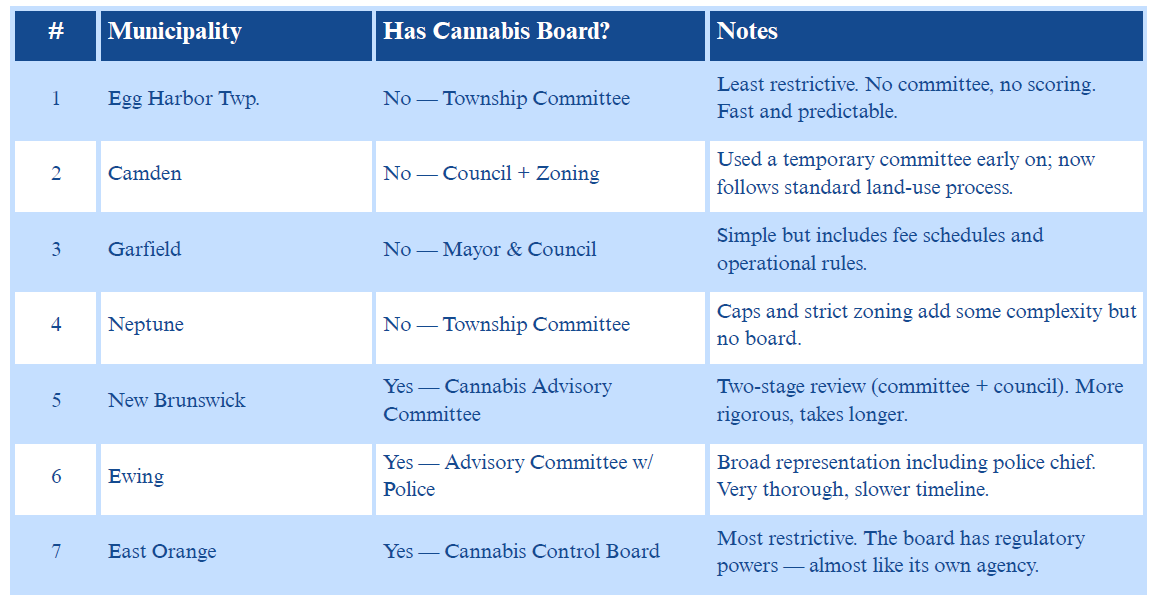
NJ Local Politics and Cannabis
Towns in New Jersey have a lot of power to control what happens within their borders. This is known as “Home Rule.” Every year, the largest political and public policy convention in New Jersey is held in Atlantic City by the League of Municipalities after the November election.
Unfortunately, less than 40 percent of towns in New Jersey are pro-cannabis. The NJCRC has been doing its best to track town cannabis policies. It’s difficult because New Jersey has more towns than California.
Many conservatives blocked cannabis dispensaries and operations in towns, even when the majority of the town voted for the 2020 cannabis legalization referendum.

NJ Cannabis Dispensaries Clusters and Deserts
If one town sees the next town that wants some revenue, it could allow a dispensary to open. However, that could take away business and tax revenue from the other town’s dispensary. Or it might generate a whole class of newbies and casual consumers eager to explore and experiment. A lot of people who consumed cannabis once or a few times in their teens and 20s have enjoyed making it a regular thing now that cannabis is legal and easily accessible.
Several dispensaries with other dispensaries nearby have been in a knife fight for survival. The towns that allowed such clusters seem indifferent or baffled by the issue.
Some towns with multiple dispensaries, like Highland Park in Middlesex County and Maplewood in Essex County, have towns around them that do not allow dispensaries, like East Brunswick by Highland Park and Livingston near Maplewood. So that is likely helping the clustered dispensaries.
Part of the issue is that licensed cannabis companies pay a high rate of federal taxes due to Section 280-E of the IRS Tax Code. So their profit margin is lower.