




The Drug Enforcement Administration (DEA) has launched a medical marijuana portal application for state-legal medical cannabis companies to apply to become federally legal as a Schedule III drug.
Table of Contents
- DEA Medical Cannabis Company Portal
- DEA MMJ Activity Questions
- DEA Liability Questions
- Federally Legal Marijuana Hearing Process
- Federally Legal Medical Cannabis Progress
- Conservative Opposition to Federally Medical Cannabis Progress
- Cannabis Unity Coalition for Decriminalization and Descheduling
- Scandals for Legal Weed?
State-legal medical cannabis companies have until June 27th to apply.
It’s unclear what will happen to those who do not.
The most significant issue this would solve is tax-related. Legal cannabis companies cannot deduct their expenses due to Section 280-E of the IRS Tax Code.


It would likely help with banking problems with accounts and loans as well.
But it does not cover state-legal adult-use recreational cannabis companies. However, a hearing process beginning in June could.
DEA Medical Cannabis Company Portal
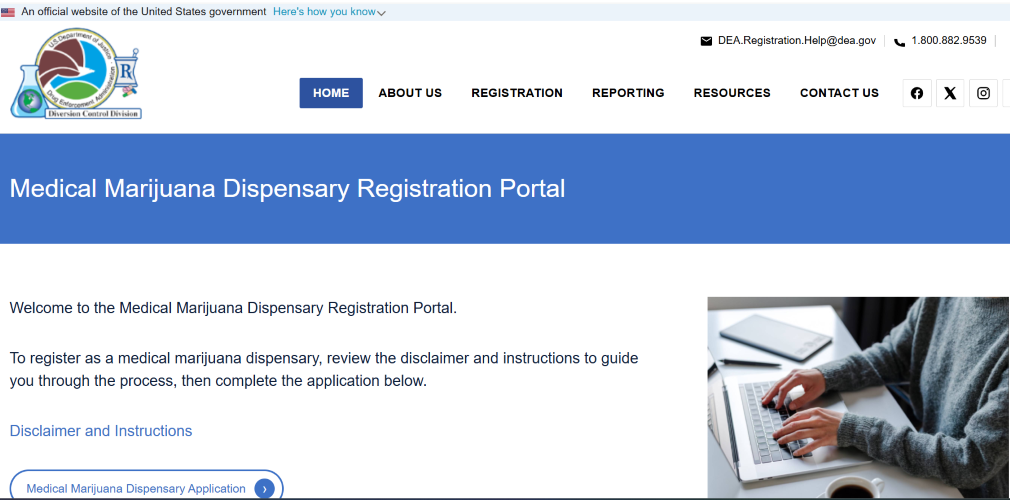
So, the DEA set up a portal very quickly to begin the process of federally legal medical cannabis companies.
The portal says, “In order to process your request to handle Schedule III medical marijuana, the Drug Enforcement Administration must obtain the information requested in this application in its entirety.”


Notably, “Your application will not be complete until you have paid the non-refundable application fee of $794 via the pay.gov website.”
DEA MMJ Activity Questions
The application asks:
- “Will your firm be handling or dispensing medical marijuana?
- Will your firm be handling or dispensing recreational marijuana?
- National Provider ID (if applicable).”
DEA Liability Questions
The application has a unique section asking about underground legacy activity. Among the questions are:
- If the applicant is a corporation (other than a corporation whose stock is owned and traded by the public), association, partnership, or pharmacy, has any officer, partner, stockholder or proprietor been convicted of a crime in connection with controlled substance(s) under state or federal law, or ever surrendered or had a federal controlled substance registration revoked, suspended, restricted or denied, or ever had a state professional license or controlled substance registration revoked, suspended, denied, restricted, or placed on probation, or is any such action pending?
- Has anyone who will be involved in the ownership or operation of the firm previously manufactured, distributed, and/or dispensed any controlled substance without a DEA registration authorizing such activity?”
Federally Legal Marijuana Hearing Process
The rescheduling marijuana hearing process that would include adult-use cannabis in Schedule III rescheduling is supposed to begin June 29, 2026.
They will take place at DEA Headquarters in Arlington, VA, across from Washington, DC.
The hearing process is supposed to end by July 15, 2026, with a 4th of July break in the middle.
Federally Legal Medical Cannabis Progress
A Notice of Proposed Rulemaking (NPRM) was recently placed in the Federal Register by the US Department of Justice (DOJ), which sped up the Marijuana Rescheduling process.
According to Reuters, this action moved state-legal medical cannabis and drug products containing cannabis that have Food and Drug Administration (FDA) approval, like Epidiolex, Marinol, Syndros, and Cesame, to Schedule III already.


The DOJ issued the Order claiming that it is carrying out obligations of the United Nations 1961 Single Convention on Narcotic Drugs.
That allowed them to move much quicker than expected to say that medical cannabis is now federally legal.
Acting US Attorney General Todd Blanche issued orders on April 23rd. Surprisingly, they moved the process forward of making medical cannabis a Schedule III narcotic/drug very quickly.
All marijuana was previously a Schedule I narcotic on the Controlled Substances Act (CSA) list. Schedule I drugs are the most illegal. They are said to have no medicinal value.


President Donald Trump (R) moved the process forward in December with an Executive Order to move marijuana from Schedule I to Schedule III of the CSA.
That was after he stopped the Schedule III process initiated by former President Joe Biden (D), which led to a hearing two years after his Executive Order.
According to Reuters, 40 out of 50 American states have legal medical cannabis programs.
Conservative Opposition to Federally Medical Cannabis Progress
There is a lot of blowback to Trump’s new pro-medical marijuana position. Republican leaders who control the United States Congress are opposed to progress.
In addition, the anti-marijuana group SAM is leading the legal fight via a lawsuit to stop the Schedule III process.
Cannabis Unity Coalition for Decriminalization and Descheduling
Recently, the Cannabis Unity Coalition led a range of national business and social justice groups lobbying Congress for Decriminalization and Descheduling.
Descheduling cannabis from the Controlled Substances Act (CSA) list would improve the state cannabis markets and ensure justice.
Their Lobby Day included a range of social justice and small business leaders that included several New Jersey leaders, like cannabis attorney Jessica F. Gonzalez of the Latino Cannabis Alliance, along with Baked by the River dispensary CEO Jesse Marie Villars and Cannademix CEO Josh Alb.
Scandals for Legal Weed?
Trump has moved toward cannabis, similar to how former New York Governor Andrew Cuomo did.
Like Cuomo, Trump initially denounced marijuana. His first Attorney General, Jeff Sessions nearly ruined the state-legal cannabis industry in 2018.
However, Cuomo then moved toward cannabis legalization as it gained popularity.
So Trump is now pro-cannabis, especially since former Multi-State Operator (MSO) Trulieve Lobbyist Susie Wiles is Trump’s Chief of Staff.
Also, like Cuomo, Trump seems to be moving towards cannabis reform amidst a scandal.
Cuomo’s scandal ultimately led him to resign the New York Governorship.