






The cannabis industry is entering a moment where it is time to reimagine healthcare and risk. CannaCoverage Insurance Services Founder & CEO Nichelle Santos is blazing a trail and taking the industry to a higher level.
Table of Contents
(Nichelle is going to be on our Women in NJ Cannabis panel at our show and party this Saturday March 14th!)
“The future of the cannabis industry will not be defined by growth alone. It will be defined by discipline, in risk management, compliance, and how we build businesses that are resilient and trusted,” she said.
Healthcare Crisis Demands Innovation
At the same time, the cannabis industry is maturing, the United States is confronting healthcare costs. Public and private sector employers face double-digit healthcare cost increases year after year.


“The healthcare system is under enormous pressure, and employers are searching for innovative ways to improve outcomes while controlling costs,” Santos said.
One solution is the integration of medical cannabis into healthcare and workplace wellness strategies since it has so many benefits.
Through its Employee Benefits division, CannaCoverage has been working with employers to explore how medical cannabis can be integrated into employer-sponsored benefit strategies.
The City of Trenton, the Teaneck Board of Education (BOE), and the Orange BOE have begun introducing employees to medical cannabis through broader wellness initiatives.


“When we talk about cannabis as medicine, we’re really talking about expanding treatment options for patients who have often exhausted traditional therapies,” Santos explained. “Employers are beginning to see that alternative therapeutics may be part of a smarter, more compassionate healthcare strategy.”
Advancing Health Equity Through Medical Cannabis Advocacy
In addition to healthcare innovation, Santos has been deeply involved in advocacy efforts to increase medical cannabis health equity and access for underserved communities.
She currently serves as State Co-Director of Minorities for Medical Marijuana (M4MM). They work with the Coalition for Medical Marijuana of New Jersey (CMMNJ) to advance patient access and policy reform.
Historically, communities of color were disproportionately harmed by cannabis prohibition. Yet they continue to face barriers in both industry participation and healthcare access.
“Health equity must remain central to the future of cannabis,” Santos said. “Medical cannabis has the potential to address chronic pain, trauma, and behavioral health challenges that disproportionately affect underserved communities. But access must be intentional and equitable.”
Santos aims to ensure that cannabis evolves into an industry that improves lives while correcting historic disparities.
She also serves as Chair of the Risk Management & Insurance Committee for the National Cannabis Industry Association (NCIA). It is the largest and most effective trade association serving the cannabis industry.
Forces Shaping the Cannabis Industry
For the past decade, cannabis industry growth has been driven by legalization, entrepreneurship, and expanding consumer markets. What began as a movement to provide patients with access to a therapeutic plant has evolved into an industry projected to exceed $50 billion in sales by 2030.


But the next chapter of cannabis will be defined by discipline, infrastructure, and purpose. Three forces are shaping the cannabis industry:
- Risk management and insurance infrastructure.
- Regulatory compliance and operational discipline.
- Integration of medical cannabis into modern healthcare systems.
Dealing with Risks
Cannabis operators today face one of the most complex regulatory environments in American business. Companies must navigate evolving state regulations, federal contradictions, compliance frameworks, banking barriers, and heightened scrutiny from regulators, insurers, and investors. This is why insurance is important.
“Insurance is not just a policy. It is a reflection of how a business manages risk, compliance, and safety,” Santos said. “When businesses prioritize those disciplines, they become stronger, more resilient, and ultimately more insurable.”


This reality is why risk management must move from an administrative task to a leadership function within the cannabis industry.
The Infrastructure of Cannabis Risk Management
Santos founded CannaCoverage Insurance Services to address a critical gap in the cannabis marketplace: the need for insurance expertise specifically designed for cannabis operators navigating complex regulatory and operational risks.
CannaCoverage’s Property & Casualty division provides specialized insurance solutions for cannabis operators, including cultivators, manufacturers, distributors, and dispensaries.
The goal is to help businesses improve risk management practices that strengthen underwriting outcomes and protect companies from preventable losses.
“In cannabis, risk management is not just about protection. It is about survival,” Santos explained. “One uninsured claim or compliance violation can put an operator out of business overnight.”
CannaCoverage aims to strengthen both business resilience and industry credibility.
“When we talk about cannabis as medicine, we are really talking about expanding treatment options for patients who have often exhausted traditional therapies. Employers are beginning to see that alternative therapeutics may be part of a smarter and more compassionate healthcare strategy,” Santos said.
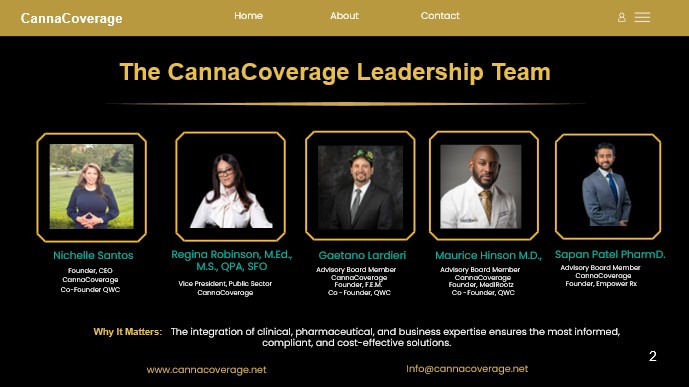
The CanaCoverage Team
The cannabis industry has spent decades fighting for legitimacy. Now it can prove its value in healthcare.
Santos has assembled an A-Team to bring this to fruition:
If cannabis operators, insurers, healthcare leaders, and policymakers collaborate, the possibilities are transformative:
• Reducing healthcare costs for employers
• Expanding safe access to alternative therapies
• Addressing the opioid crisis through harm reduction
• Generating meaningful patient outcome data
• Advancing health equity
“Cannabis has always been about more than business,” Santos said. “At its core, this industry began with patients seeking relief. As we build the next phase of the market, we have a responsibility to honor that origin and ensure that innovation serves both health and humanity.”
The next era of cannabis will belong to leaders willing to build a resilient, responsible ecosystem that improves lives.