




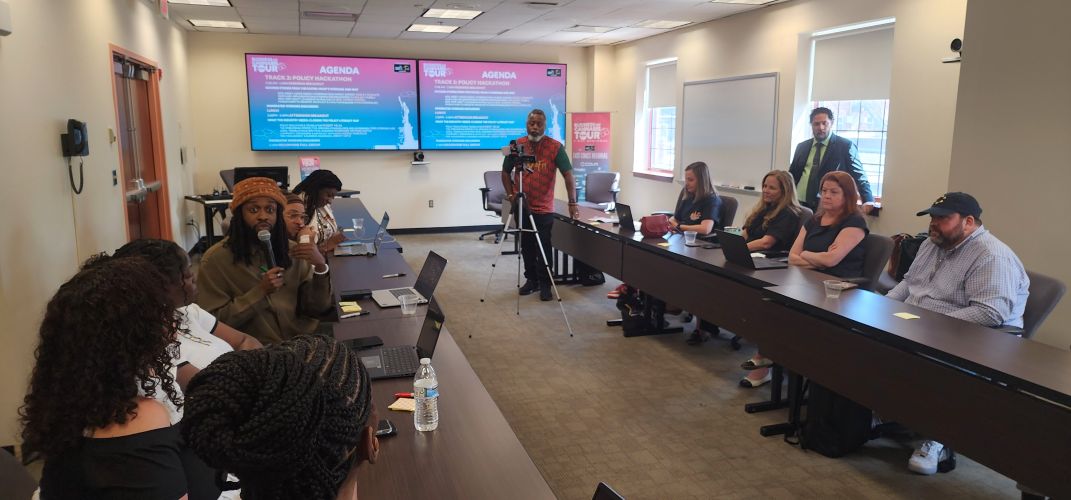
The Minority Cannabis Business Association (MCBA) held its latest industry conference tour in Jersey City, highlighting issues and progress.
Table of Contents
Many leading experts gave speeches on how to help minorities succeed in the cannabis industry through tips or policy changes, followed by robust discussions.
Building Better Markets for Minorities in Cannabis
The conference tracks included an intimate series of lectures by policy experts and a roundtable discussion. During one session, NJ Cannabis Regulatory Commission (NJ-CRC) Director of Inclusion and Equity Wesley McWhite noted the need to work with non-profits to improve the market.


“I would have wanted us to walk arm-in-arm with non-profits saying here is where we are with our rules and regs…,” he explained about doing things differently at the beginning of the NJ adult-use cannabis market.
McWhite noted the NJ Cannabis Training Academy took a great while to launch, which was difficult in the early years of the NJ cannabis market. Many of those who would have benefited from the classes had already applied for licenses, while larger operators seized market share.
An Underground Legacy Operators Advocacy Association
“Legacy needs a trade association,” McWhite declared. “…Legislators wanted to get the collective opinion of legacy and hear one voice….”
“We did a lot of stakeholder engagement with legacy folks,” he argued.


McWhite said they did try to make their website easy to understand for many as a result.
“The solution we’re exploring is actually looking at the more corporatized trade group. It has several legacy members on its board,” MCBA Chair Mike Lomuto noted.
He noted the need to talk about legacy issues within an existing cannabis trade group, for example.
“We don’t have the resources… We don’t have the ability to do friends and family rounds (of investment seeking)…,” Lomuto explained.
“There was a legacy organization that was founded. But it was about finding career path opportunities, non-profit opportunities, licensing opportunities…,” attorney and advocate Scheril Murray Powell noted about the Justus Foundation, which she launched.
She wanted to create a strict definition of legacy operators that would be prioritized in licensing.
“Money wants money to go first…,” Powell noted.
She also explained that the Unified Legacy Operators Council (UNLOC) was created in New York to address such issues as well.

The NJ Cannabis Market V. Other Legal Cannabis States
Stockton Professor Rob Mejia, who has written a cannabis book, compared the New Jersey cannabis market to other state cannabis equity efforts.
He said it’s easier to do the right thing first than to fix something in government.
“Looking at California, Washington, Colorado… that had a totally different setup. You can take a lot of lessons,” Mejia said.
“Avoid municipal opt outs…,” he argued. “This leads to too much cannabis clustering or deserts.”


Unfortunately, doing so was too difficult in New Jersey, where “Home Rule” has been dominant for more than 100 years.
“More license classes means more opportunities,” Mejia explained.
He said New York has a unique cannabis nursery license to foster different cannabis plants.
“You’re selling seeds… clones… lighting,” Mejia noted.
Such places can also become education hubs for professionals.
In addition, Mejia said there are NY Cannabis Showcase licenses where license holders can sell products at certain events.
“Those licenses make a lot of sense,” he noted.
“Ensure some of the cannabis revenue goes to a social equity fund and there is a mechanism to spend it,” Mejia explained.
He also recommended the cannabis training academy, like the one in New Jersey, as well as in Massachusetts and Illinois.
“State grants and loans are lifelines for businesses,” Mejia declared.
He noted the early years of a business are the hardest.
At an overall wrap-up of the first day, people from both tracks met to discuss the issues. Meyon “Meme” Wiggins of Memes Danckk World dispensary noted she has been in operation in Jersey City after attending earlier conferences, which was great progress.
Notably, NJCRC Vice Chair Jackie Ferraro was present at the conference, avidly listening to the speech lectures, but did not publicly speak.